

We’ve been participating in the Raise Your Cup campaign through Equal Origins, which is a celebration of women farmers — coinciding with 2026 as the Year of the Woman Farmer. Every day, from Oct 1 through 15, the campaign is posting the story of a woman coffee or cocoa farmer, told in her words.
Each woman was nominated by a partner, and InterAmerican Coffee was delighted to nominate Aurora Izquierdo, director of the ANEI cooperative in Colombia, whose coffee we’ve been purchasing for more than a decade.
Aurora’s story posted Oct. 6 — we hope you’ll like and share it! If the post reaches 200 shares by the end of the campaign, we’ll donate $2,000 to a women farmer–led effort. So please, help boost the numbers!
The campaign also includes a beautiful page on each farmer — with answers to questions in her native language, as well as English. The template allows for a particular word count, so Aurora’s answers were edited. Having seen her complete answers, however, we wanted to offer you the chance to read them as well — and get to know her more fully.
We hope you’ll enjoy the below, engage with the campaign and —above all — raise your cup to women farmers!
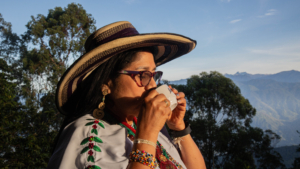
The following questions were asked by Equal Origins and answered by Aurora Maria Izquierdo Torres, director of the ANEI cooperative and a producer of both coffee and cocoa. The following was translated from Spanish.
————
What knowledge, skill or achievement are you most proud of?
I feel deeply proud to have been able to put my knowledge at the service of my people and to have understood that the knowledge we receive does not belong solely to us. It is knowledge with a purpose: to share it, to place it at the service of the community, and to use it to contribute to the well-being of those around us.
I had the opportunity to be the first Arhuaco Indigenous woman to leave my community to study and experience other worlds. It was a journey that allowed me to acquire new knowledge and view my territory from different perspectives. Yet, upon returning to my community, I realized that everything I had learned needed to merge with the wisdom of our elders and the knowledge our ancestors have passed down through generations.
As an Arhuaco woman, I learned that the land does not belong to us. We belong to the land, and we have a duty to care for it, respect it and maintain balance for those who come after us. That is why one of my greatest sources of pride has been dreaming of and helping to build ANEI—a pathway to strengthen our own economies, our culture, our autonomy and our relationship with Mother Earth.
Coffee and cacao became the vehicle to unite these two worlds: the knowledge acquired outside our territory and the ancestral wisdom living within our communities. Through them, we have found a way to produce and generate income and well-being for families, while also protecting our identity, strengthening our communities, and demonstrating that it is possible to develop our economies without ceasing to care for the land.
Today, I am filled with pride to see so many families finding the possibility of a dignified future on their farms; to see our young people educating themselves, participating, and stepping into leadership roles; and to see our women recognizing the value of their work, their knowledge, and their farms as spaces where they, too, can generate well-being and create opportunities for their families.
For me, the true achievement is not merely that our coffee and cacao reach other countries. The true achievement lies in knowing that behind every grain there is a family able to live a better life, a woman empowered to strengthen her autonomy, a young person able to find purpose within their community, a culture that can remain alive, and a land we can pass on to future generations.
That is the purpose that has guided my path: ensuring that what we build today is not just for us, but also for those yet to be born. It is the hope that our work may endure from generation to generation and that, one day, our children, our grandchildren, and the generations to come can look back and know we did our part to care for life, culture and the land.
What organization or program you have participated in to help your family or community?
Through ANEI, we have worked for many years to strengthen the well-being of Indigenous and farming families in the Sierra Nevada de Santa Marta and the Serranía del Perijá.
ANEI was born precisely from that purpose: to strengthen local economies, protect our culture and create opportunities for families to remain in their territories with dignity. Coffee and cacao have been the means to realize that purpose.
We have promoted training initiatives and good agricultural practices—including organic and agroecological farming—as well as ecosystem conservation, reforestation and the restoration of areas vital to the region. We have also worked to help families strengthen their food sovereignty so they do not rely solely on a single crop or external markets.
A crucial part of this journey has been working with women. We want women to recognize the value of their work and build their capacities; we want them to view their farms not merely as places to live but as opportunities to generate income, build autonomy and improve their families’ living conditions. Through initiatives like the ANEI Mujeres Tejedoras (Women Weavers) program, we have sought to strengthen their leadership, training in agroecology, entrepreneurship and overall well-being.
We have also worked with young people, knowing that the territory’s future depends on them finding reasons to stay, participate, and lead. The ANEI Jóvenes Guardianes del Territorio (Young Guardians of the Territory) program aims to ensure generational continuity by providing training and opportunities for youth to engage in the organization’s production, administrative and commercial processes.
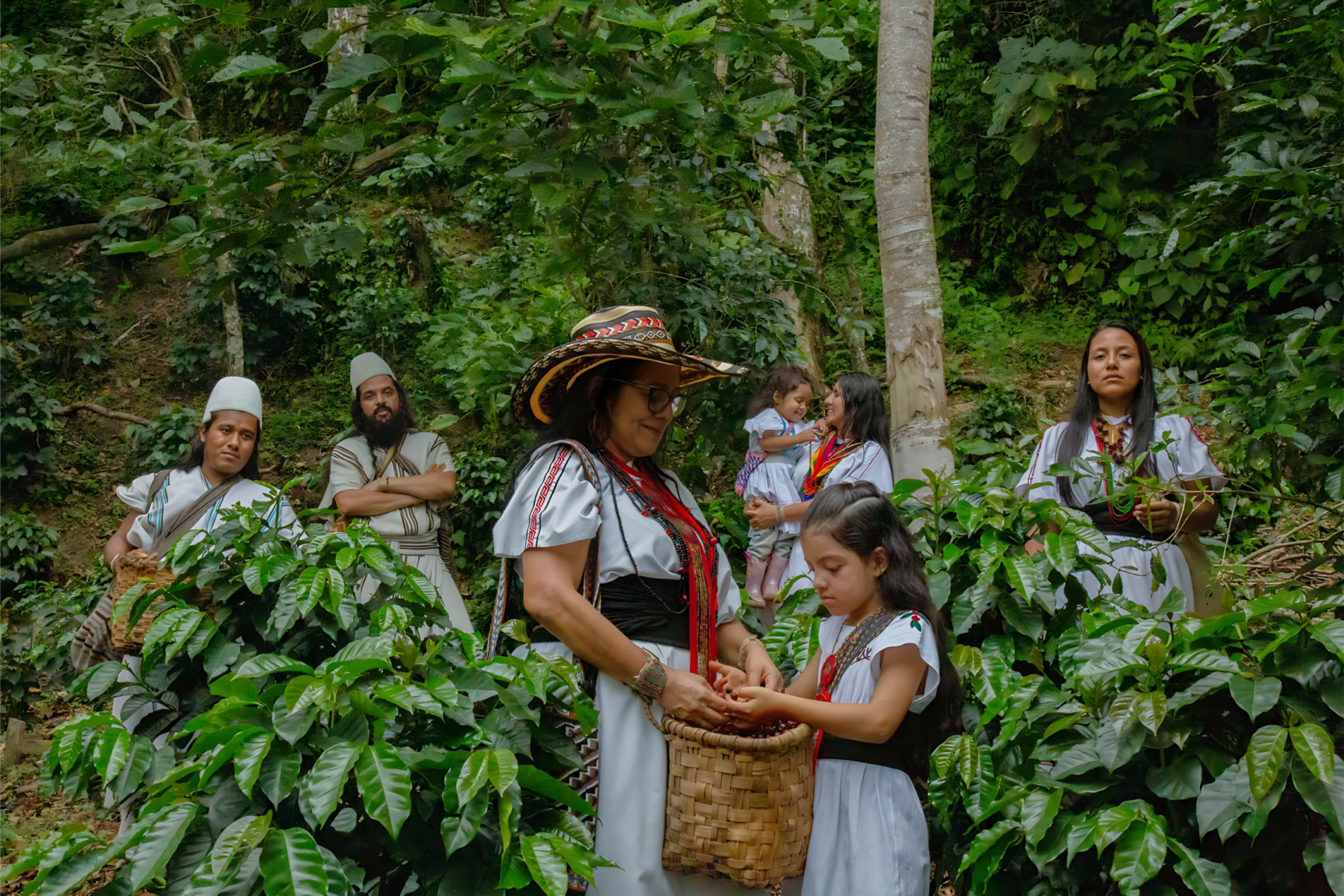
Conservation has also been a fundamental pillar. We have driven initiatives to reduce our carbon footprint and have promoted reforestation, agroforestry systems, micro-watershed recovery, seed conservation, and biodiversity protection. For us, this is not merely an environmental project; it is an ancestral responsibility toward Mother Earth.
All this work has been made possible thanks to ANEI, our network of committed clients, and the partnerships we have built over the years. The most important thing for me is that these processes do not stop with a single generation. We want knowledge, land, and opportunities to be passed down from parents to children, and for the generational transition to be permanent and sustainable.
What makes farming difficult?
Agriculture teaches us every day that we depend on nature. Changes in the climate, rainfall patterns, droughts, crop diseases, difficulties in accessing the land, and market conditions make production a constant challenge.
For us, there is also a deeper challenge: producing food and generating income without disrupting nature’s balance.
As Indigenous peoples, we know that Mother Earth has her own rhythms and that we must learn to work while respecting her cycles. We cannot think only about how much we can produce today; we must consider the kind of land we will leave behind for tomorrow.
It is also a challenge to ensure that new generations find opportunities in rural life. If young people do not find the conditions to build their lives and futures on the land, knowledge is lost, culture is eroded, and the continuity of our communities is broken.
That is why we must strive not only for productive agriculture but for agriculture that enables us to live with dignity, strengthen our families, preserve our land, and keep our identity alive.
What helps you overcome the difficulties?
I draw strength from my community, the wisdom of our elders and our connection to Mother Earth.
It also helps to remember that no significant undertaking is built in isolation. ANEI has become a reality because many families believed in a shared purpose and because we found people and organizations willing to weave a future alongside us.
Spirituality reminds us to maintain a balance between the material and the spiritual. When we face difficulties, we return to our principles, listen to our elders, and recall why we embarked on this journey.
I am also supported by education, technical knowledge, and the ability to learn from others without leaving our ancestral wisdom behind. I believe the future lies in that dialogue between knowledge and tradition.
And, above all, thinking of future generations gives me strength. When you work with your children, grandchildren and great-grandchildren in mind, you find the resolve to keep going.
What is one hope or aspiration for your future?
My hope is that we can continue building a territory where our families can live with dignity, where young people want to stay and lead their communities, where women enjoy ever-greater autonomy, and where our children can grow up proud of their roots.
I dream that ANEI will continue to serve as a bridge between our territory and the world, carrying not only coffee and cacao but also a message of respect and care for Mother Earth.
I want us to demonstrate that it is possible to produce and generate development without destroying nature; that our own economies can be strengthened and our products can serve as a means to bring well-being to our communities.
My vision extends beyond us. At ANEI, we think in terms of seven generations. What we do today must benefit those who have not yet been born.
My greatest aspiration is to hand down to those generations a living territory—one rich in forests, water, food, culture, and strong communities.
What should others know about your experience as a woman farmer?
For me, being a woman farmer means bearing a great responsibility toward life itself.
We do not merely cultivate the land. We sow food, care for our families, pass on knowledge, and help keep our peoples’ cultures alive. A significant part of caring for life and the land lies in our hands.
Throughout my journey, I have learned that a woman can transform so much when she has the opportunity to develop her abilities and strengthen her knowledge, and when she finds a community that believes in her. That is why I have always said that the time for women has arrived.
We women possess a profound gift for nurturing, protecting and giving life. We have the capacity to be great leaders when given the opportunity and when we trust in our own knowledge. I believe women can help cool the planet, because our way of relating to the earth is rooted in care, protection and consideration for the well-being of those who come after us.
That is why it is so important for rural women to have access to education, training and new opportunities, without losing sight of the wisdom passed down by our mothers, grandmothers and elders. When a woman strengthens her knowledge and recognizes the value of what she knows, she strengthens her family and her community as well.
I have also learned that we must not separate production from life. A farm is not merely a place where coffee or cacao is produced; it is a space where we can grow food for our families, preserve our seeds, protect water sources, care for trees, teach our children and keep our connection to the land alive.
I want others to understand that behind a cup of coffee or a cacao product lies much more than just a crop. There is a family, a history, a culture, a body of knowledge and a territory.
And when that product is born of respect for nature, it carries a responsibility: the responsibility to care for Mother Earth and to think not only of the present but also of the generations yet to come.
What is a belief, saying or quote that inspires you?
One of the things that inspires me most is the belief that, as we journey through life, we should strive to maintain a tranquil heart—free from envy, ill will and desires that could harm our fellow human beings. When one possesses peace of heart and clarity of thought, one can visualize what truly matters and find the path to make it a reality.
I believe that dreams are born first in the mind. When one has a clear purpose, holds it in one’s heart, and works with discipline and perseverance, the path to achieving it gradually reveals itself. We do not always know exactly how we will get there, but when there is genuine intention and we work in harmony with others, opportunities arise and the path is built step by step.
I also believe deeply in balance. Everything in the world is interconnected: the individual with the community, the community with the land, human beings with nature, and the present with future generations. We are spiritual beings, and our lives cannot be separated from Mother Earth. That is why we must learn to live in harmony, taking only what is necessary and giving back to the earth a portion of what she provides to us.
This mindset has also guided my journey with ANEI. When I dreamed of building an organization that could generate well-being for the families in my region, I was not thinking only of the present. I was thinking of our children, our grandchildren and those yet to be born—because everything we do today has consequences for tomorrow.
It inspires me to know that a seed we plant today can grow into a tree—one that we might not live to see in its full maturity, yet one that will provide shade, nourishment and life to others. That is how I view our work: We do not plant only coffee and cacao; we plant opportunities, knowledge, leadership, conservation and hope.
That is why I believe we must walk with a tranquil heart, a clear mind and a purpose that extends beyond ourselves. What we do with love, balance and a focus on collective well-being can transcend our own lives.
My greatest inspiration is the thought that every decision we make today should help future generations find a path that allows them to continue building upon what we started.
What would you want the person drinking your coffee, or enjoying your cacao, to know about you?
I would like you to know that when you drink our coffee or enjoy our cacao, you are receiving more than just a product. You are receiving a small part of our history, our culture and our land.
Behind every bean lies a family; there are hands that have worked the land with dedication, as well as mountains, rivers, trees and seeds. There is also knowledge passed down through generations and a worldview in which we understand that nature is not separate from us, but rather a part of our own existence.
I hope that those who drink our coffee or enjoy our cacao can feel that, through them, they are connecting with a sacred land. I hope they can picture the mountains of the Sierra Nevada de Santa Marta, hear the waters flowing from them and understand that behind every bean stands a people working to care for and maintain the balance of this place.
For us, coffee and cacao have served as a vehicle to share a message with the world: that we can produce, generate well-being for our families, and strengthen our communities while still caring for Mother Earth.
The Sierra Nevada de Santa Marta is our home, but for the peoples who inhabit this territory, it is also the Heart of the World—a sacred place where life begins and upon which the balance of many other lives depends.
What change in the coffee or cocoa industry would help you, and other women farmers, thrive?
We need an industry that truly recognizes the value of those who produce.
We—women and farming families—must have better opportunities to access knowledge, financing, technology, markets, and prices that allow us to make a decent living from our work.
We also need consumers to know the story behind every product and to understand that quality lies not only in the cup or the chocolate itself, but also in how it was produced and the living conditions of those who made it possible.
For women, it is especially important to open up more spaces for leadership and decision-making. When a woman strengthens her capabilities and can make decisions regarding her farm and her finances, she changes not only her own life but also the lives of her family members, and she strengthens her entire community.
I would like to see an industry that places greater value on the knowledge of producer communities and understands that sustainability cannot be merely environmental; it must also be economic, social, cultural and spiritual.
Is there anything you’d like to share that we haven’t asked?
I would like to share that the story of ANEI did not begin with a business. It began with a dream and a sense of responsibility toward my community.
When I returned to my homeland, I realized that the knowledge I had gained needed to be put to the service of our people. That is how the idea was born to forge a path that would strengthen our own economies while simultaneously protecting our culture and our territory.
Over the years, we came to understand that coffee could be far more than just a product. It could be a means to generate well-being, create opportunities, unite communities and share our message of caring for Mother Earth with the rest of the world.
Today, after so many years, I still believe that true development is not merely about having more; it is about living in balance.
I want our families to have food, education, opportunities and a dignified life. I want our women to be recognized as leaders. I want our young people to find reasons to continue the path of their elders. And I want our children to inherit a healthy, vibrant territory.
That is why we keep moving forward. That is why we continue to weave our lives together in community and in harmony with nature.
Because our work is not just for ourselves. It is for those who come after us.
It is for seven generations. •